
The Future of VR Storytelling: AI, Fantasy Art, and Fully Fictional Character Design
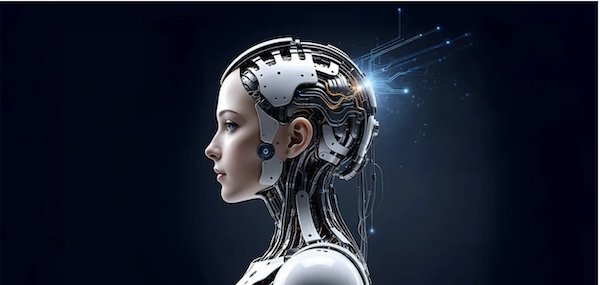
Over the past few years, something unique has happened in the world of Virtual Reality. Instead of using VR simply for entertainment like video gaming or viewing 360-degree videos, people have started entering the space to live in stories that they can also impact, sometimes unconsciously as well. Much of this shift is occurring due to VR content developers beginning to combine Artificial Intelligence with fantasy-inspired character design into the worlds they create.
The most interesting thing about the potential of combining these two elements is how natural and intuitive this will be. AI doesn't replace an individual’s creativity but instead provides individuals a means to express themselves creatively on a much greater scale than would otherwise be possible.
AI Is Becoming a Creative Shortcut, Not a Crutch
Ask anyone who has tried building a VR character from scratch: it’s hard. You have to model the shape, texture the body, rig the skeleton, adjust the physics, test expressions—the list goes on. For many beginners, the entire process feels like trying to sculpt a statue with a spoon.
AI has changed that. Not by finishing everything for the creator, but by removing the “blank page” problem. Tools inspired by platforms like Ai Hentai give people quick sketches, color ideas, silhouettes, and emotional cues. They act almost like a creative partner whispering, “What if the character looked like this instead?”
Sometimes the generated image isn’t perfect. Sometimes it looks strange or messy. But that’s what makes it useful—it nudges the creator in a direction they might not have explored alone.
Why VR Works Better With Fictional-Only Characters
Something unexpected has happened in VR social spaces: people have started to prefer fictional identities over realistic ones. Realistic avatars can feel stiff or uncanny inside a headset. They don’t always express emotion clearly, and they often bring real-world expectations with them.
A fictional character, especially one with stylized or fantasy features, removes all that pressure. A glowing fox creature doesn’t need perfect realism to feel alive. A soft pastel-themed spirit character doesn’t need photo accuracy. In fact, many VR users say they feel more like themselves when they’re not using a human avatar.
AI tools tied to Ai Hentai help people build these fictional identities faster. They let users explore shapes, moods, and personalities that would be tough to sketch on their own. It’s not just design—it’s self-expression.
VR Storytelling Isn’t About Plot; It’s About Presence
Traditional stories follow a structure: intro, conflict, resolution. VR stories don’t work that way. They feel more like moments—things you walk into and experience firsthand.
Imagine stepping into a floating forest with glowing plants. Or a warm lantern-lit room in the middle of winter. Or a sky village where you can sit on the edge and watch worlds drift by. Those scenes don’t need a written script. The environment itself becomes the story.
Fantasy-inspired art and AI-generated concepts help worldbuilders come up with places like that. A single AI sketch might show a purple-lit swamp or a city built on the back of a giant creature. A creator takes that sketch and turns it into a VR scene players can literally walk through. The mood carries the narrative.
Roleplay Worlds Are Quietly Redefining VR
If you’ve ever stepped into a VR social server late at night, you’ve probably seen it—people sitting around a digital fire, telling stories in character. Not scripted stories. Not rehearsed. Just spontaneous storytelling between avatars who look nothing like their users.
Someone might play a dragon-like guardian. Someone else might be a tiny creature that glows when excited. Someone might be a wandering traveler who changes outfits depending on the server they’re in.
These interactions become long-running arcs. Friendships evolve. Characters change. Worlds change with them.
AI-generated illustrations make it easier for players to build these avatars in the first place. You can mock up an idea, hand it to a 3D modeler, and bring that character into VR within days. It’s a cycle: the art inspires the character, the character inspires the story, and the story shapes the world.
Creators Are Mixing Art Styles Like It’s Nothing
What is so exciting about the present state of Virtual Reality (VR) is that artists are creating very mixed-up and experimental visual styles in their work. An artist may take elements of design from such things as Anime, Watercolor Art, Cartoon Shading, Creature Design, and Soft Fantasy Paintings to create a single character.
AI tools encourage this mix because they don’t follow strict art rules. If you ask for a character with “bright moss-green markings, glassy eyes, and moonlit fur,” you’ll probably get something strange and beautiful. That odd combination often sparks a new idea the creator didn’t expect.
And in VR, unusual becomes memorable.
Worlds Built for Emotion, Not Realism
- A lot of new VR worlds aren’t trying to look like life. They’re trying to feel like something—calm, excited, curious, surreal. Storytelling in VR happens through atmosphere:
- lighting that shifts as you move
- colors that hint at emotion
- ambient sounds that change with your actions
- small environmental details that invite exploration
Fantasy characters look more at home in those spaces than realistic avatars do. A soft, stylized creature fits naturally inside a glowing dreamscape. A neon-winged dragon-person fits in a futuristic floating city. AI-generated concepts offer creators a shortcut to discovering those moods.
Where This Is All Headed
VR is moving in a direction where imagination plays a bigger role than accuracy. People want worlds that feel personal, characters that feel expressive, and stories that react to them rather than lead them.
AI tools are speeding up that transformation. They help beginners start faster. They help experienced creators push boundaries. They help players build identities that feel safe and exciting.
The future of VR storytelling won’t be about perfect visuals. It’ll be about expression—how people shape their digital selves and how those selves shape the worlds around them.
VR is becoming a place for stories that grow organically, one moment at a time, guided not by scripts, but by the personalities of the people living inside them.